Some towns were built to be lived in. Others were built to be looked out from — and people came to live in them later.
A white town
beneath a castle
Four in the afternoon, October, the sun still behaving like summer. First stop: the town the Portuguese call the Sintra of the Alentejo.
A photograph has a quality you don't notice until you open the frame's data: it remembers the time. The first picture of this day was taken at 16:07, the last at 19:25. In between lie two small towns in the São Mamede hills right on the Spanish border, less than half an hour's drive, and an hour and a half of low sun. There were two of us — my wife Irina and I.
You see Castelo de Vide from a long way off: white houses climbing the hill in steps towards the castle, a square tower and two spires above the roofs. The Portuguese call it the Sintra of the Alentejo — for its greenery, its springs and the castle over the town. It became a municipality in its own right, split off from neighbouring Marvão, in 1276; the walls you see today were raised by Kings Dinis and Afonso IV in the 14th century.
The streets here don't run, they fall. Steep, paved with small stones, white walls hung with drying laundry, a bell tower at the end of every other lane. On one of the slopes lies the old Jewish quarter, the Judiaria.
Below the Judiaria runs the Fonte da Vila, a 16th-century marble town fountain where for centuries people drew water and did their washing. But it isn't the most famous spring in town.


The doctor of Goa
and the captain of April
A small town on the edge of the country gave Portugal two men who each, in his own way, changed how it looks at the world.
Around 1501, into a family of Jews who had fled here from Castile, a boy was born and named Garcia de Orta. He studied medicine at Salamanca and Alcalá de Henares, sailed for India in 1534 and stayed in Goa for the rest of his life. In 1563 his book, the Colloquies on the Simples and Drugs of India, was printed there in Goa — one of the first European books on tropical medicine and botany. Orta was the first European to describe the symptoms of Asiatic cholera. The verse preface was written by his friend, Luís de Camões.
More than four centuries later, on 1 July 1944, Fernando Salgueiro Maia, a railwayman's son, was born in Castelo de Vide. In the small hours of 25 April 1974 the 29-year-old captain led a column of armoured vehicles out of Santarém towards Lisbon. That day his men took the government quarter and then surrounded the barracks where Prime Minister Marcelo Caetano had taken refuge — and a dictatorship that had stood for almost half a century surrendered without a fight. So began the Carnation Revolution, and the Lisbon we wrote about in our first issue became a different city.
Before setting out, the story goes, Salgueiro Maia lined up his soldiers and told them something like this: there are socialist states, there are capitalist states, and there is the state we've ended up in — and whoever wants to change it, come with me. Every one of them, they say, stepped forward. After the revolution he sought neither office nor power, and he died in 1992, aged forty-seven.
Today a rust-red sculpture stands right in the centre of Castelo de Vide — bodies arched into bridges, a torso growing out of a stone pillar. Against the white walls and baroque churches it looks as if the town has decided to argue with its own past.


The eagle's nest,
843 metres up
Less than half an hour of hairpins — and the road runs into a wall. From here on, you walk, through the gate.
Marvão doesn't stand on a mountain — Marvão is the mountain, finished off by human hands. The quartzite ridge of the Serra do Sapoio, a spur of the São Mamede range, drops away sheer here, and the walls were laid straight onto the rock: at first glance you can't tell where the stone ends and the masonry begins. The castle stands 843 metres above sea level. People often call it the eagle's nest, and standing on the wall, with cloud shadows drifting across the valley below your feet, you don't feel like arguing.
The town is named after a man. In the 9th century a muwallad — a local who had converted to Islam — called Abd al-Rahman ibn Marwan rose against the emirs of Córdoba and, it is believed, made this rock his refuge. Tradition also credits him with founding Badajoz, the Spanish city just across the border. Russian, as it happens, spells the town "Marvan" under its standard transcription rules — exactly the name of its founder. Our Russian edition keeps the more familiar travellers' spelling, but Ibn Marwan is worth remembering.
Inside the walls: a few streets, white houses with granite window frames, a carved stone doorway, a church on the very edge of the drop — most likely Santa Maria. Higher up, the castle: the keep, walls following the crest of the rock, little sentry boxes — guaritas — on the corners. The castle holds a huge cistern for rainwater: under siege the garrison had its own supply, and thirst could not take what assault had failed to.
José Saramago, who travelled the length of Portugal in 1979–1980 for his book Journey to Portugal, wrote that from Marvão you can see the whole earth. It's not a metaphor. From the wall you can see Spain, the São Mamede ridge, and the valley below with white villages scattered like spilled salt.


The Fantastic
War
A war in which there was hardly any fighting — and a garrison that kept five thousand men out of a fortress.
In 1762 Europe was playing out the last act of the Seven Years' War, and Spain, France's ally, decided to punish Portugal, England's ally, while it was at it. Spanish armies crossed the border. The Portuguese named the campaign the Guerra Fantástica — the Fantastic War: there were hardly any big battles in it, and the armies did more marching than shooting.
But at Marvão they shot. A Spanish force of four to five thousand men attacked the fortress head-on. It was met by an Anglo-Portuguese garrison under Captain Thomas Browne — and beaten back. The rock, which is almost impossible to climb except by the road to the gate, did what it had done since the days of Ibn Marwan: it turned a handful of defenders into an army. In November that year Spain asked for a truce.
Walk the walls today and you can see how it worked. Narrow loopholes with room for nothing but a glance. Staircases inside the walls, steep and one person wide. Gates opening onto passages where there is no room to turn or to charge. The fortress is written in a language in which every word means "no".


It wasn't the walls that defended Marvão — it was the height. The walls just said so out loud.Secrets Service · Marvão
The fortress stands on the quartzite ridge of the Serra do Sapoio, a spur of the São Mamede range, right on the Spanish border.
Portugal’s first king takes Marvão. The Almohads retake it in 1190; in 1226 Sancho II grants the town its charter.
Captain Thomas Browne’s garrison beats back a Spanish force of 4,000–5,000 men.
One of only two synagogues in Portugal to survive the expulsion of 1496. The Torah ark was found in 1972; a museum since 2019.
The whole earth
and a bridge at dusk
The sun sets over Portugal, and Spain, to the east, goes dark first. The last frames are taken down below, by the river.
At around half past six the light turns low and warm, the shadows stretch across the valley, and everything below — olives, oaks, white villages — seems to draw closer. A large bird circles slowly over the wall. Which kind, you can't tell from that height, but eagles and griffon vultures both live in the São Mamede hills, so Marvão may have earned the name eagle's nest for more than its altitude.
At the foot of the rock, in the valley of the river Sever, lie the ruins of the Roman town of Ammaia. In the 4th century some six thousand people lived here, in a town of up to twenty-five hectares. Its stones were scattered across the countryside: they say Roman blocks still sit in the walls of old houses and the bridges of the valley.
The day's last frames were taken down below, at 19:21 and 19:25: an old stone bridge over dark water — most likely the one at Portagem — trees, dusk. Up on the rock stood the fortress that has watched over this valley for more than a thousand years. Now it was our turn to look at it — from below.
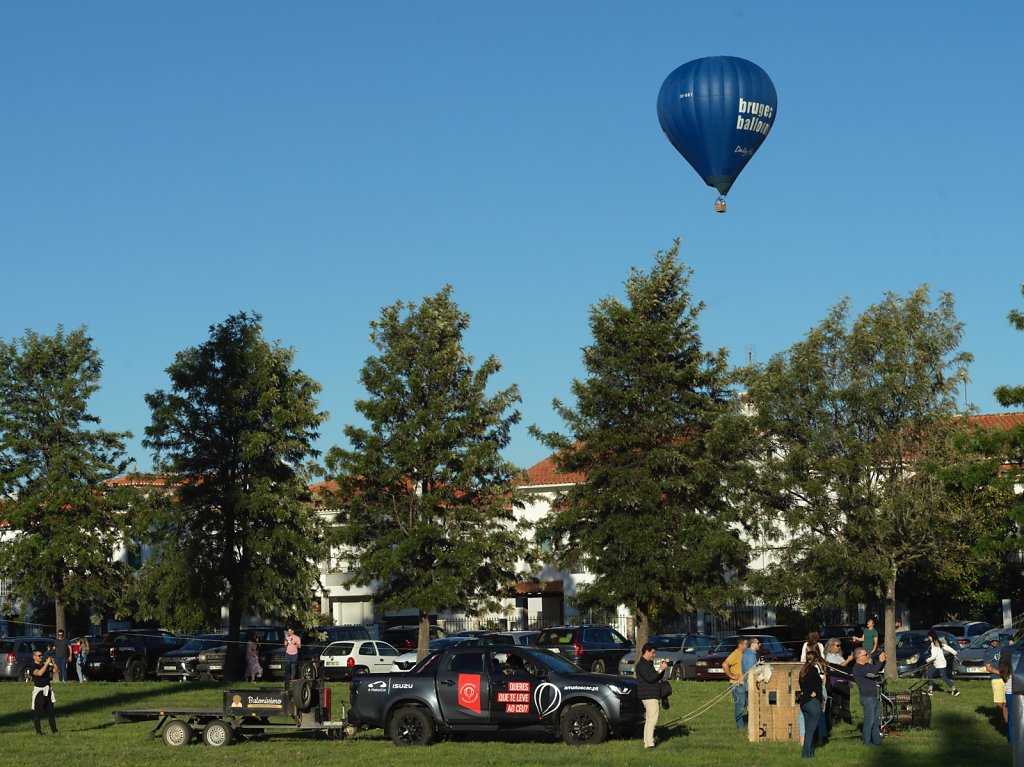
Two and a half weeks later, in November, we were back in the Alentejo, watching hot-air balloons rise over the cork oaks of Ponte de Sor. But that is the next story, and we told it in issue № 13.


A day on the Spanish border
From Lisbon to Castelo de Vide is about two and a half hours by car; between the two towns, less than half an hour of hairpin bends. The sensible order is ours: Castelo de Vide by day, Marvão for sunset. The light on Marvão's walls is best in the last hour before the sun goes down, and from the eastern side you can watch Spain darken.
In Castelo de Vide: the synagogue and the Judiaria, the Fonte da Vila, the castle and its view; on the main square, Praça Dom Pedro V, there is a market on the last Friday of the month. In Marvão, leave the car at the gate — it's narrow inside the walls. The castle is ticketed; walk the full circuit of its walls — from the north side you can see the whole São Mamede ridge. Down in Portagem there's the 16th-century bridge and a river beach on the Sever, and nearby the ruins and museum of Ammaia.
In autumn Marvão holds a chestnut fair, in summer an International Music Festival; the municipality announces exact dates each year. Spend the night up top, inside the walls: in the morning, they say, the fortress often stands above the clouds.